PRIVACY POLICY / TERMS & CONDITIONS

-
Call Now +86 19025276800
-
Any Questions Emily@sunwaymachinegroup.com
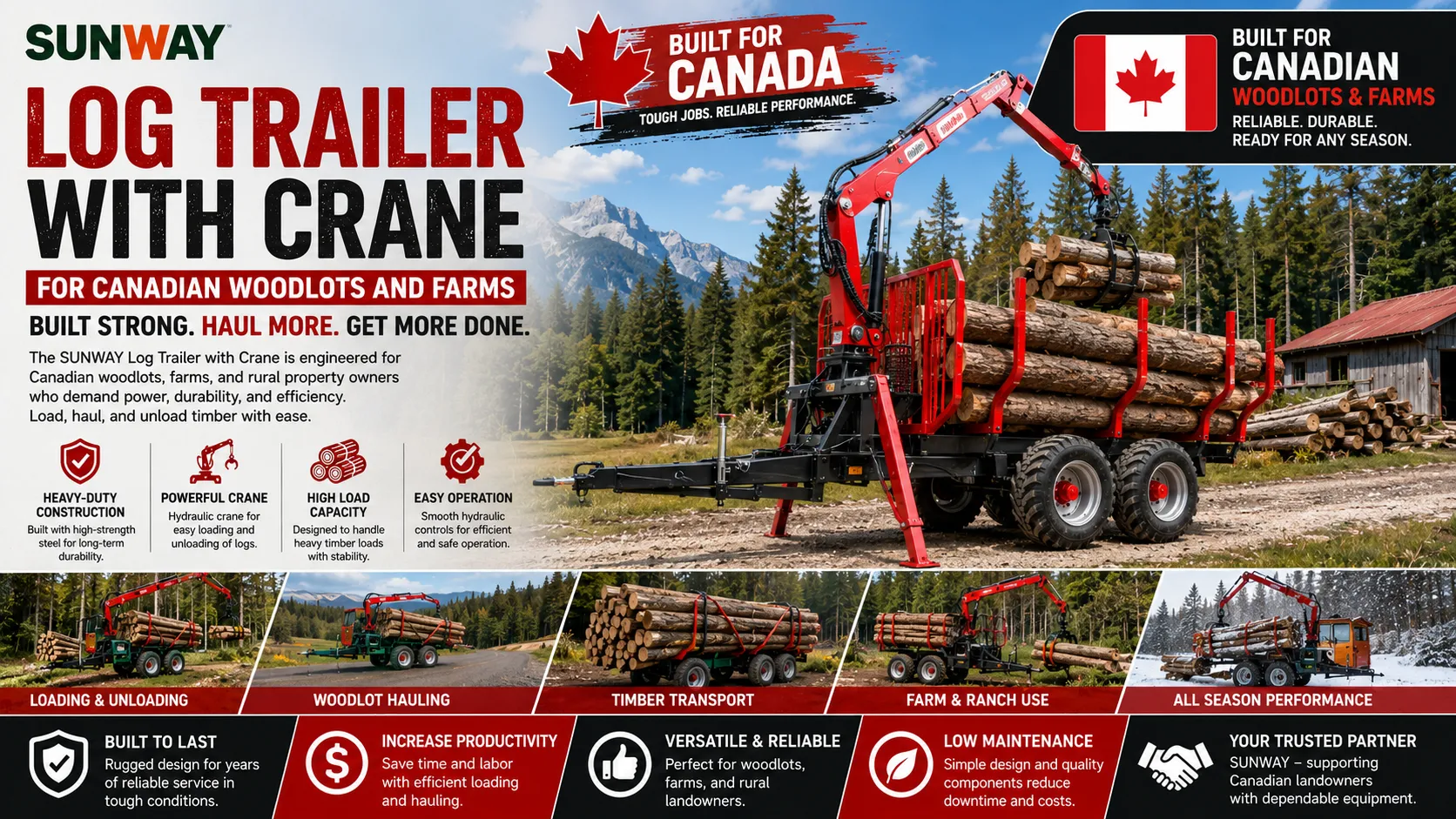
Log Trailer with Crane for Canadian Woodlots and Farms
A practical guide to selecting a log trailer with crane for Canadian woodlots, farms, and rural contractors, from capacity to terrain and support.

A log trailer with crane can help Canadian woodlot owners, farmers, forestry contractors, and firewood businesses move timber from the cutting area to a landing or processing point. Selecting the right unit requires more than choosing a nominal payload. Terrain, log size, tow vehicle, crane reach, hydraulic supply, road access, and seasonal conditions all influence the final configuration.
Sunway supplies log trailers with cranes from compact farm-oriented units to larger forestry models. For many rural buyers, the first comparison is between versatile mid-range sizes rather than the largest available trailer.
Match the trailer to the tow vehicle
Start with the tractor or other approved tow vehicle. Confirm available hydraulic flow and pressure, hitch arrangement, braking requirements, permissible loads, and the conditions in which the combination will operate. A trailer that is technically towable may still be unsuitable for soft ground, slopes, narrow trails, or repeated heavy work.
The 3T log trailer can be considered where manoeuvrability and lighter rural work are priorities. The 5T log trailer provides another reference for buyers handling larger loads or more regular operations. Final suitability depends on the complete specification and local requirements.
Think about logs, not only tonnes
Record the usual log length, diameter, species, and quantity per trip. Long stems, short firewood lengths, and mixed woodland material create different loading patterns. The position and adjustability of the bunks or stakes should support the material being carried.
Crane reach and lifting performance should be assessed across the working area, not at one point. Ask the supplier for the relevant load information and discuss how far logs typically sit from the trailer. Controls, operator position, stabilisation, and grapple configuration also affect day-to-day use.
Canadian operating conditions
Woodlot access can change significantly through the year. Mud, snow, frozen ground, side slopes, stumps, and tight turns should be included in the purchasing discussion. Tyre choice, ground clearance, trailer width, articulation, and optional drive or braking arrangements may matter more than maximum payload on paper.
Buyers should also confirm how the equipment will be transported or used near public roads. Applicable registration, lighting, braking, towing, and workplace rules vary by location and application, so local requirements need independent confirmation.
Questions for suppliers
- What payload and log dimensions suit the proposed configuration?
- What are the crane reach and load characteristics?
- What hydraulic supply is required?
- Which hitch, brake, lighting, and stabiliser options are available?
- Can bunk or stake positions be configured for the buyer’s timber?
- What are the trailer’s overall transport dimensions and weight?
- Which wear parts and hydraulic components are normally stocked?
- What documents, manuals, and packing details are supplied?
Common buying mistakes
Avoid choosing a trailer solely from payload. A useful unit must work with the tow vehicle, trail width, crane task, and timber mix. Buyers should also avoid comparing crane reach without comparing lifting ability at the intended distance.
Another frequent oversight is service planning. Hydraulic hoses, pins, bushings, grapple components, tyres, and brakes work in demanding conditions. Ask how parts are identified and how replacements are shipped before the equipment is needed in season.
Frequently asked questions
Is a 3T or 5T trailer better for a private woodlot?
It depends on the tractor, terrain, access, log size, trip frequency, and loading expectations. A smaller unit may be easier to manoeuvre; a larger unit may reduce trips when conditions and towing capacity allow.
Can one trailer handle both sawlogs and firewood material?
Potentially, but the bunk layout, stakes, grapple, crane reach, and expected log dimensions should be reviewed for both tasks.
What should be sent with an enquiry?
Include tow-vehicle details, hydraulic information, trail conditions, typical log dimensions, desired payload range, destination, and photos of representative work if available.
Request a woodlot configuration
Explore the Sunway log trailer range and submit your tractor, terrain, timber, and crane requirements through the request a quote form. Sunway can use those details to prepare a more relevant equipment proposal for your Canadian operation.
